By Shabbir Ali Mallah
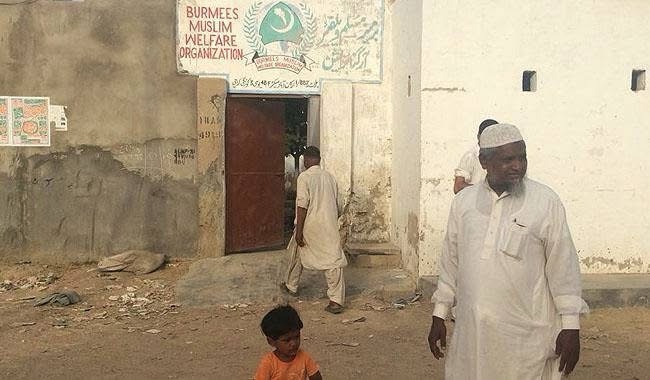
At just ten years old, Muhammad Rasheed’s journey began when his family fled Myanmar’s southern coastal state of Rakhine. Their path took them through Bangladesh, India’s Kolkata and Kashmir, before finally settling in Pakistan’s Sindh province—specifically, Karachi. Today, Rasheed is 41, a fisherman by trade, father to six children, and one of the estimated 350,000 to 500,000 undocumented Rohingya Muslims living in Karachi.
This figure excludes those who arrived legally between the 1960s and the 1971 war, many of whom became Pakistani citizens. Rasheed identifies as Rohingya, earning Rs. 500–600 daily, and remains deeply connected to his siblings in Myanmar—though his communication with them was severed just a week ago amid escalating violence.
According to the UN refugee agency, over 300,000 Rohingya have fled to Bangladesh in just two weeks. Meanwhile, Pakistan’s National Database and Registration Authority (NADRA) holds records for only 59,000 undocumented Rohingya migrants in Karachi. Most reside in Arakanabad, a colony named after their homeland, without official refugee camps or identity cards. Yet they work in factories, run businesses, and own mobile phones—despite biometric verification requirements for SIM cards.
Even after the 1971 war closed borders, the Rohingya continued arriving via Bangladesh, India, and Kashmir. Karachi remains accessible and, for many, the final destination.
Local Rohingya communities report frequent harassment by police and other agencies demanding identification documents they do not possess. “We’ve lived here for decades—where else can we go?” asks Rasheed.
Community leader Noor Hussain Arakani insists, “The time has come for the Pakistani government to grant us citizenship. We are Pakistani Rohingya now. We are not a burden—we are hardworking people.” He claims thousands of Rohingya work in Karachi’s factories, though he did not specify how they secured employment despite their undocumented status. He calls for equal access to healthcare, education, and sanitation, stating, “We deserve equal rights. We’re not going anywhere.”
A NADRA official, speaking anonymously, revealed that no reliable data exists on Karachi’s Rohingya population, as many have assimilated into the local demographic. Furthermore, local residents are often unwilling to assist in identifying undocumented migrants.
A UNHCR report challenges the Pakistani Interior Ministry’s stance that incoming Rohingya do not qualify as legal refugees and have failed to register. The report urges Pakistan to take the issue seriously—establish camps, conduct registration, and formally recognize them as refugees.
Failure to register and contain refugee populations could lead to security concerns, especially in the current regional climate. The recent wave of violence in Myanmar—sparked by coordinated attacks on 25 police posts and the killing of 12 officers—was claimed by the militant group Harakat-ul-Yaqeen. The International Crisis Group (ICG), based in Brussels, suggests that the group’s operational links may extend to Karachi, where some fighters allegedly received training.
However, Shahid Umar, head of Karachi’s Counter-Terrorism Department (CTD), told CNN that no concrete evidence supports these claims.
Whether or not Karachi is linked to militant activity in Myanmar, one fact remains: the city has become the world’s largest urban refuge for Rohingya Muslims. Estimates suggest their population—legal and undocumented—exceeds half a million.
Noor Hussain Arakani remains hopeful that citizenship will be granted soon. Even Senator Murtaza Wahab of the Pakistan Peoples Party has echoed this demand.
Sources: CNN, UNHCR Report, Daily Dawn
 Indusdaily.com
Leave a comment